What This Is
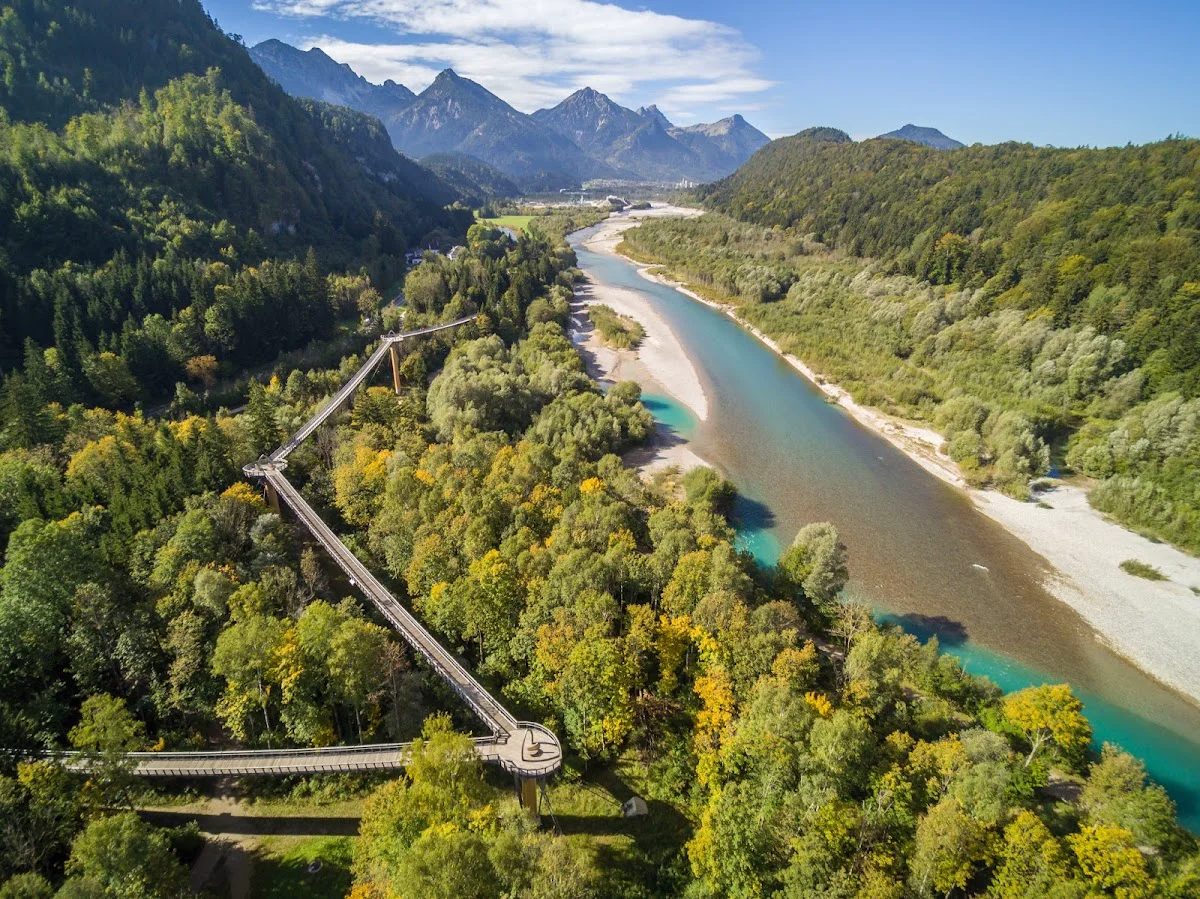
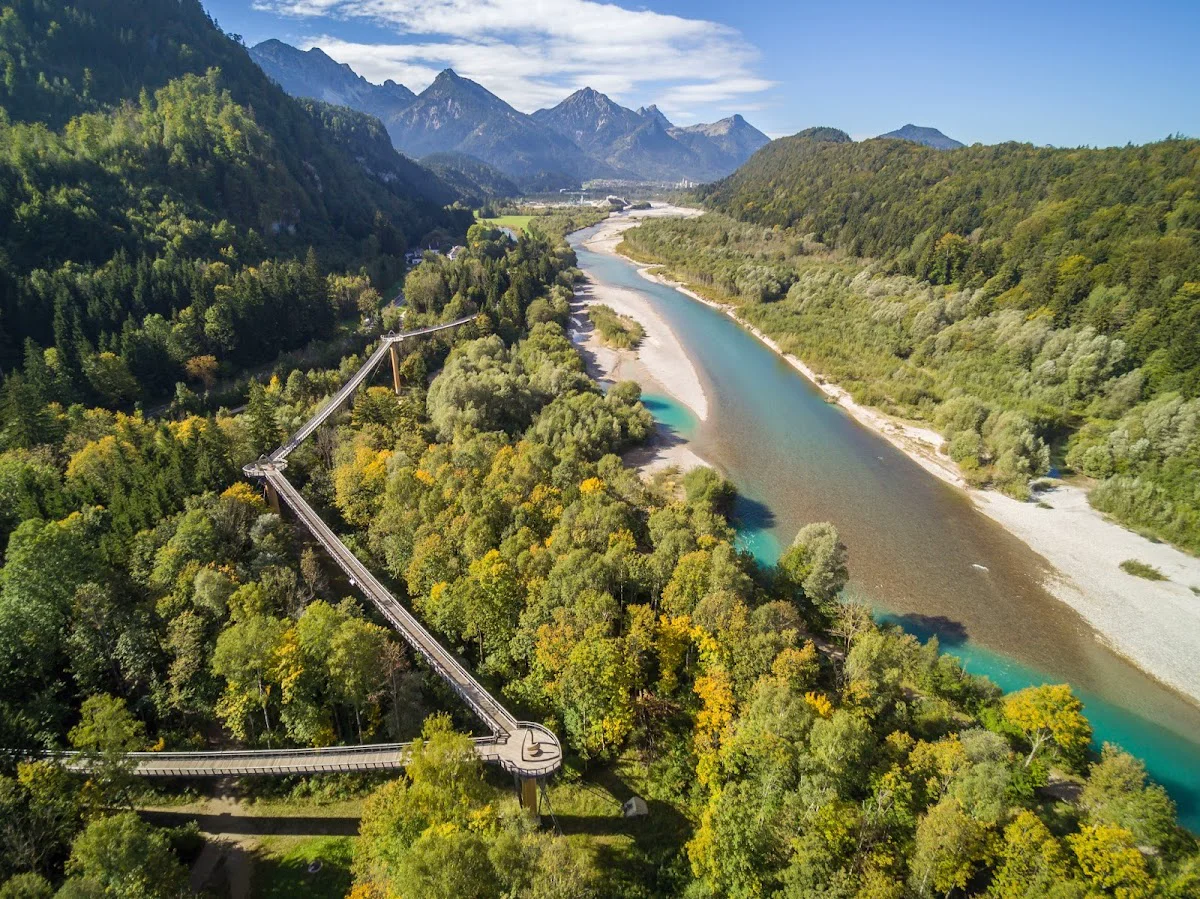
The Walderlebniszentrum Ziegelwies is a forest experience center centered on a 480-meter treetop walkway that physically crosses the international border between Bavaria (Germany) and Tyrol (Austria). The structure reaches 21 meters in height and spans the wild Lech River—the last free-flowing alpine river in the Bavarian region. At €5 for adults with children under 15 entering free, it's positioned as a high-value, low-barrier nature experience rather than an extreme adventure activity.
Primary Purpose
Nature education and scenic observation. The walkway provides accessible canopy-level views while the ground trails and exhibition center focus on forest ecology and the Lech River ecosystem.
The Border Experience
The mid-point of the walkway marks the exact Germany-Austria boundary, with flags clearly indicating where Bavaria ends and Tyrol begins—a unique transnational feature unavailable at other canopy walks in the region.
Accessibility Profile
Fully wheelchair and stroller accessible via elevator or ramp. The rigid construction and wide pathways make this one of the few truly barrier-free elevated nature experiences in the Alps.
Parking Strategy
P2 lot: €5/day, 100 spaces, 5-minute walk to entrance. Overflow lot available 10 minutes away (free). Best time: Arrive before 10 AM or after 4 PM to avoid crowds.
Pricing
Adults €5.00 | Children (0-14) FREE | Family of 4: €10 total. Cash and cards accepted at entrance.
Timing
Peak times: Weekends 11 AM-3 PM (avoid). Best visit: Weekday mornings (8-10 AM) or late afternoons (after 5 PM) for minimal crowds.
Access
Tiroler Str. 10, 87629 Füssen. From Munich: 1h 45min drive. Public transit: Bus 78 from Füssen Bahnhof (10 minutes).

The Structure & Experience
Engineering & Construction
The Baumkronenweg (treetop walk) is not a swaying adventure bridge—it's an engineered promenade designed for stability and longevity. The pathway is constructed primarily of larch wood, selected for its high resin content and natural resistance to alpine weather cycles. The wood will weather to blend into the surrounding forest canopy rather than appearing as a stark industrial structure.
The walkway is supported by four massive pillars with foundations driven 14 meters deep into the alluvial soil of the Lech riverbank. This deep piling is necessary due to the hydrological instability of the riverbank environment—the Lech is an active alpine river that still floods seasonally. The structure stretches 480 meters in total length with a maximum height of 21 meters above the forest floor and river surface.
The "Sway Factor": Engineering reports note that "the bridges move when walked upon by multiple people." This is not a defect but a calculated characteristic of suspended timber structures. It provides a subtle vibration through the soles of your feet—a gentle reminder of elevation—but the rigid steel-plate reinforced construction prevents the terrifying instability found in rope bridge designs.
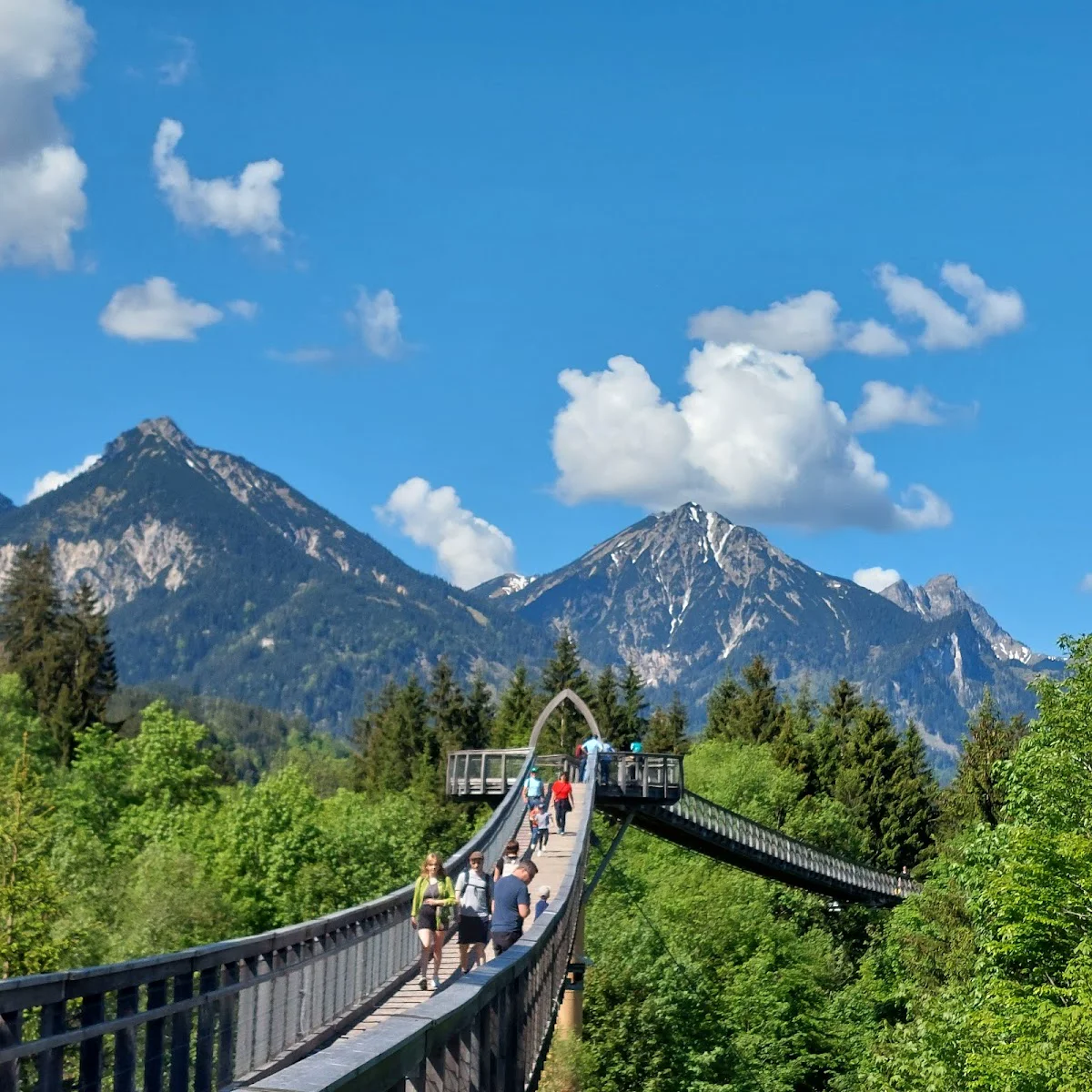
The 21-meter height is substantial—roughly equivalent to a 6-story building. The barriers are high, robust, and psychologically reassuring. The metal grating allows you to see through to the river below, creating a sense of transparency without compromising safety. For visitors with acrophobia, this can trigger a physiological stress response, but the overall design prioritizes visual exposure over physical danger.
The Geopolitical Element: The Border Crossing
The defining feature of this walkway is its transnational capability. The structure physically spans the Lech River, which marks the geopolitical border between the Federal Republic of Germany (Bavaria) and the Republic of Austria (Tyrol). Historically, the Lech has been a wild river and formidable natural boundary. The idea of casually walking across it at canopy level serves as a symbolic conquest of this alpine barrier.
The border line is explicitly marked on the wooden deck with clearly visible flags: Bavaria's blue and white diagonal stripes on one side, Tyrol's red and white horizontal bands on the other. This creates the opportunity for the "Border Straddle"—standing with one foot in each country—which has become the signature photograph from this location. It's high "social currency" content that validates the visit and provides tangible proof of the cross-border experience.
The Sensory Environment: The Wild Lech
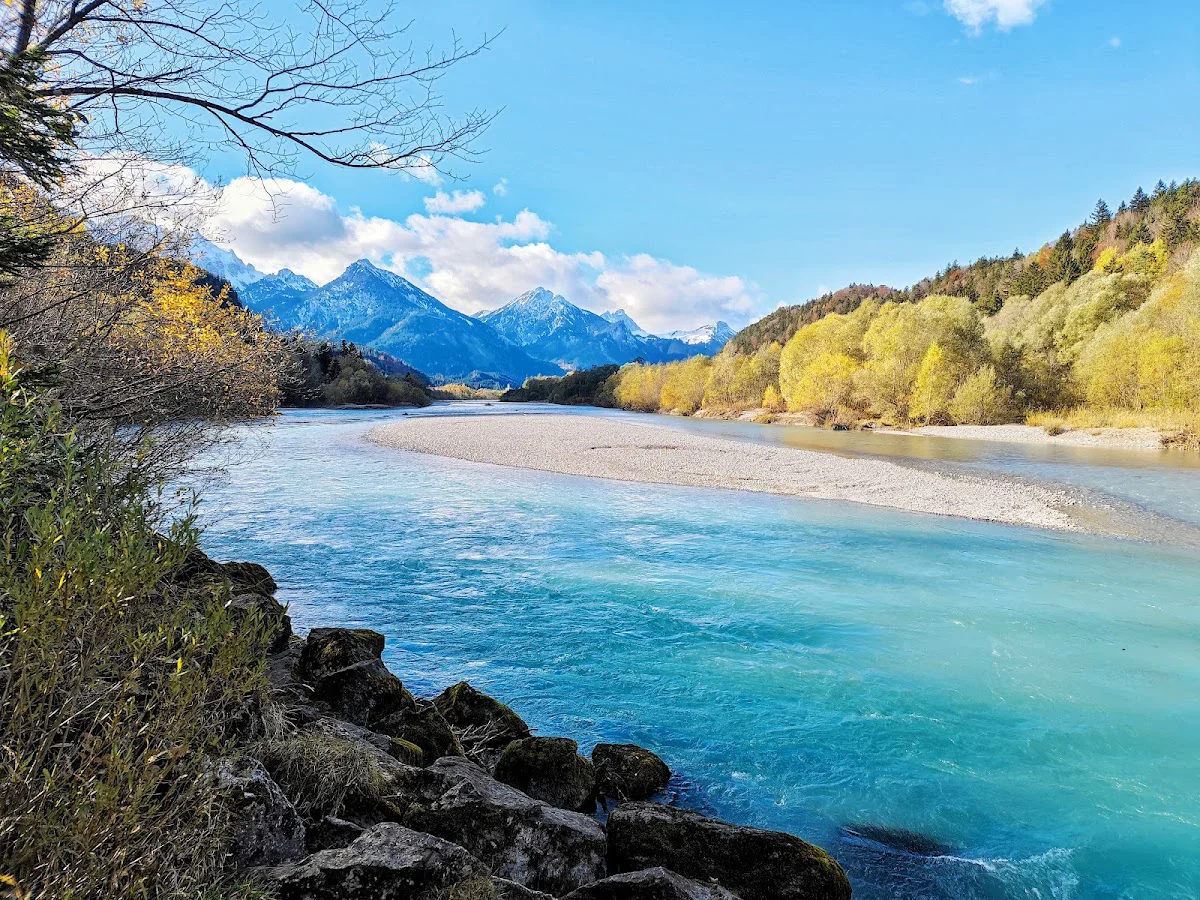
The auditory and visual backdrop of the entire experience is dominated by the Lech River below. The river is known for its distinctive turquoise-green color, a result of glacial rock flour—finely ground minerals suspended in icy meltwater that scatters sunlight. This creates a vivid, almost artificial-looking blue-green that contrasts sharply with the darker forest greens and photographs exceptionally well, especially with a polarizing filter to cut glare.
The Lech at this point is recognized as "the only gorge in the entire Bavarian Alpine region through which a larger Alpine river can still flow freely" without being dammed or channelized for hydroelectric power. This "wildness" adds a layer of raw nature to what is otherwise a highly engineered and controlled experience. The constant white-noise roar of rushing water below provides acoustic immersion and reinforces the alpine setting even when the path itself feels safe and civilized.
What Makes This Different from Other Canopy Walks?
Bavaria has approximately 20 treetop walkway attractions scattered across the region. What distinguishes Ziegelwies:
- International Border Crossing: The only canopy walk in Germany that physically crosses a national boundary
- Wild River Integration: Direct views of an undammed alpine river with glacial coloration
- True Barrier-Free Access: Many "accessible" attractions require some stair navigation—this has full elevator/ramp systems
- Free Ground Trails: Two separate forest trails (Auwaldpfad and Bergwaldpfad) are free and include features like raft crossings and giant swings
- Proximity to High-Rope Alternative: The Hochseilgarten Füssen is only 2-3km away, allowing visitors to combine low-kinetic scenic experiences with high-kinetic adventure activities in a single day
- Price Point: At €5 for adults, it's significantly cheaper than comparable attractions (e.g., Baumwipfelpfad Allgäu-Bayerisch Schwaben charges €7-9)
Location & Access
The "Last Mile" Reality
Address: Tiroler Straße 10, 87629 Füssen (on the B17, exactly at the border bottleneck)
Parking Strategy
| Lot | Location | Capacity | Cost | Notes |
|---|---|---|---|---|
| P1 (Bavarian Side) | Germany | ~10 spaces | Free | Mostly disabled parking. Always full. |
| P2 (Tyrolean Side) | Austria | ~150 spaces | FREE (06:00-20:00) | PRIMARY LOT. Easy to secure early. |
Insider Hack: If P2 is full, drive to Lechfall Parking (500m away) or Bad Faulenbach lot and walk. Adds 10 minutes but saves stress. DO NOT attempt "stealth camping" in vans—it's strictly enforced under the Tyrolean Camping Act.
Public Transit
- Bus Line 100 (Direction: Reutte) from Füssen Train Station
- Stop: "Ziegelwies Walderlebniszentrum" (~100m from entrance)
- Frequency: Check VTT or MONA app—cross-border buses have irregular intervals
- Walking: 20-30 min flat walk from Füssen station via riverside path (more scenic than road route)
Money Reality
Pricing Breakdown
| Category | Price | Value Assessment |
|---|---|---|
| Adults | €5.00 | Excellent |
| Kids (<15) | FREE | Unbeatable |
| Groups & Exhibits | FREE | Exhibition center + ground trails included |
For a family of 4 (2 adults, 2 kids): Total = €10. Compare that to €60+ for Neuschwanstein. This is the best-value attraction in the region for infrastructure quality.
Hidden Costs? Almost None.
- Parking: Free at P2 (06:00-20:00)
- Food: "Waldimbiss" (Forest Snack Bar) charges standard Bavarian tourist rates (€4-€8 for currywurst/fries)
- Equipment: None needed
- Payment: Cash recommended for snack bar (cards accepted at entrance)
Budget Tip: Use the snack bar for hydration/quick energy, but save your meal budget for proper sit-down dining in Füssen Old Town (Madame Plüsch or Hotel Ludwigs recommended).
Perfect Timing
Seasonal Windows
Prime Season: Late May through early September. The forest canopy is lush, the river is stunning turquoise, and daylight extends to 19:30 opening hours.
- Summer (May-Oct): Open daily 09:00-19:30. Extended hours for sunset photography.
- Winter (Nov-Apr): Restricted to 10:00-16:00 or 16:30. Ground trails NOT maintained (snow may require boots/snowshoes).
Weather Warning: The treetop walk CLOSES IMMEDIATELY during heavy rain, storms, thunderstorms, or snow accumulation. Metal grating + wood = slippery death trap. Check walderlebniszentrum.eu before heading out.
Crowd Avoidance Strategy
The "Castle Spillover" Effect: When Neuschwanstein tickets sell out (daily by 10 AM in peak season), disappointed tourists flood nearby alternatives. Expect a secondary wave at WEZ around 11:00-12:00.
Best Times to Visit:
- Early morning (10:00 AM opening): Beat the crowds, crisp air, better wildlife spotting
- Late afternoon (after 16:00 in summer): "Golden Hour" lighting for photography, families leave for dinner
- Weekdays (Tue-Thu): Significantly fewer tourists than weekends
What to Expect
The Full Experience Walkthrough
Duration Breakdown:
- Treetop Walk Only: 30-45 minutes at a casual pace with photo stops
- Treetop Walk + Exhibition: 60-75 minutes
- Treetop Walk + One Ground Trail: 90-120 minutes
- Full Experience (All Trails + Exhibition): 2.5-3 hours
Budget 1-3 hours total depending on your pace, whether you're traveling with children (who will want to engage with the interactive trail elements), and whether you explore the ground trails. The variable height profile of the treetop walk means you'll naturally slow down at scenic viewpoints—the mid-point border crossing typically sees a "traffic jam" of visitors taking the signature photo.
The Treetop Walk (Baumkronenweg):
- Length: 480 meters of elevated pathway
- Max Height: 21 meters (6 stories)
- Construction: Larch wood with deep-piled foundations, slight sway when crowded
- The Border Moment: Mid-point crossing where Bavaria meets Tyrol—flags mark the exact line
- The Views: Looking down into the glacially-fed turquoise Lech River, framed by alpine peaks
Beyond the Canopy
The entrance fee includes access to TWO ground-level trails (often overlooked!):
- Auwaldpfad (Alluvial Forest Trail): 1.5 km loop, features a raft crossing and connects directly to Lechfall waterfall. Flat, easy, perfect for extending your visit.
- Bergwaldpfad (Mountain Forest Trail): 1.7 km with more elevation. Includes giant swings, climbing webs, and a secret viewpoint framing Neuschwanstein Castle through forest—rarely seen on postcards!
What to Bring/Wear
- Footwear: Sneakers or light hiking shoes (metal grating can be slippery when wet)
- Layers: Can be windy at canopy level even on warm days
- Camera: Absolutely essential for border photo + river shots
- Water: Bring your own or buy at Waldimbiss
- Sun protection: Limited shade on the walkway itself
Content Creation Gold
Shot #1: The Border Straddle
Location: Mid-point of Treetop Walk
Composition: Camera on ground, split shot showing one foot on German flag, one
on Austrian flag
Caption Ideas: "Walking to Austria for lunch" or "One small step for man, one
giant step into Tyrol"
Popularity: This is the most frequently shared image from this location
Shot #2: The Turquoise Line
Location: Looking straight down from walkway into Lech
River
Composition: Deep green pines contrasted against glacial blue-green water
Pro Tip: Use a polarizing filter to cut glare and saturate water color. The
elevated perspective gives a drone-like angle WITHOUT needing a drone
Best Time: Mid-morning to early afternoon when sun angle is optimal
Shot #3: Secret Castle View
Location: Bergwaldpfad (Mountain Forest Trail),
Schwansee viewpoint
Subject: Neuschwanstein & Hohenschwangau framed through forest opening
Why It's Special: This angle is rarely photographed—no crowds, natural
framing
Timing: Sunset (17:30-18:30 in summer) for magical light
Camera Rules & Restrictions
- Drones: STRICTLY FORBIDDEN. The Lech gorge is a protected nature reserve + sensitive border zone. Heavy fines enforced.
- Handheld cameras/phones: Totally fine. GoPros and gimbals welcome.
- Tripods: Allowed but keep them compact—walkway can get crowded
Combo Strategy: Full-Day Itinerary
Don't treat WEZ as an isolated event. The region's geography allows you to chain multiple attractions for a "Full Spectrum" day combining kinetic thrills and scenic relaxation.
The "Full Spectrum" Itinerary
🌄 Morning (10:00-13:00): Hochseilgarten Füssen FOC
3 hours of climbing + 230m Flying Fox. Burn energy early while the body is fresh. Located at Füssen
Outlet Center, just 2-3km from WEZ.
🍴 Lunch (13:00-14:30): Füssen Old Town
Madame Plüsch (cozy atmosphere + Spätzle) or Hotel Ludwigs (indoor courtyard)
🌲 Afternoon (15:00-17:00): Walderlebniszentrum Ziegelwies
Decompress on the treetop walk. Golden hour photography. Educational exhibits.
🏰 Sunset (17:30-18:30): Schwansee via Bergwaldpfad
Secret castle viewpoint—Neuschwanstein framed by wet meadows and mountain forests, zero crowds
Other Nearby Activities (15 min radius)
- Lechfall Waterfall: 10-min walk via Auwaldpfad, stunning cascade
- Hochseilgarten Füssen: 2km west, high-rope course with 230m zip line (€23, 2-3 hours)
- Forggensee Lake: 5km, swimming/kayaking in summer
- Neuschwanstein/Hohenschwangau Castles: 8km, book tickets weeks in advance
Insider Intel & Local Secrets
Mistake #1: Arriving at 11 AM on a Saturday
This is when the "Neuschwanstein Spillover" hits. Come early (10 AM) or late (after 16:00).
Mistake #2: Skipping the Ground Trails
Most tourists never leave the treetop walk. The Bergwaldpfad leads to the "Sims-Wasserfall" and the
secret Schwansee castle viewpoint—almost zero foot traffic.
Mistake #3: Assuming You Need to Book
No booking required for individual entry. Buy tickets on-site.
Local Secret: The "Lechfall-to-WEZ Loop"
Park at Lechfall (if P2 is full), visit the waterfall first, then walk the scenic riverside Auwaldpfad
to WEZ. You'll enter from the scenic side and avoid parking stress entirely.
High-Rope Alternative Nearby:
Hochseilgarten Füssen is located 2km away and offers a different experience profile:
14-meter high rope courses, 230m Flying Fox zip line, and an indoor climbing option for bad weather. WEZ
focuses on observation and education; the Hochseilgarten focuses on physical climbing and kinetic
activity.
Practical Information
Winter (Nov-Apr): Daily 10:00-16:00 or 16:30
CLOSES during storms, heavy rain, snow
Photos provided by Google | Content based on comprehensive field research