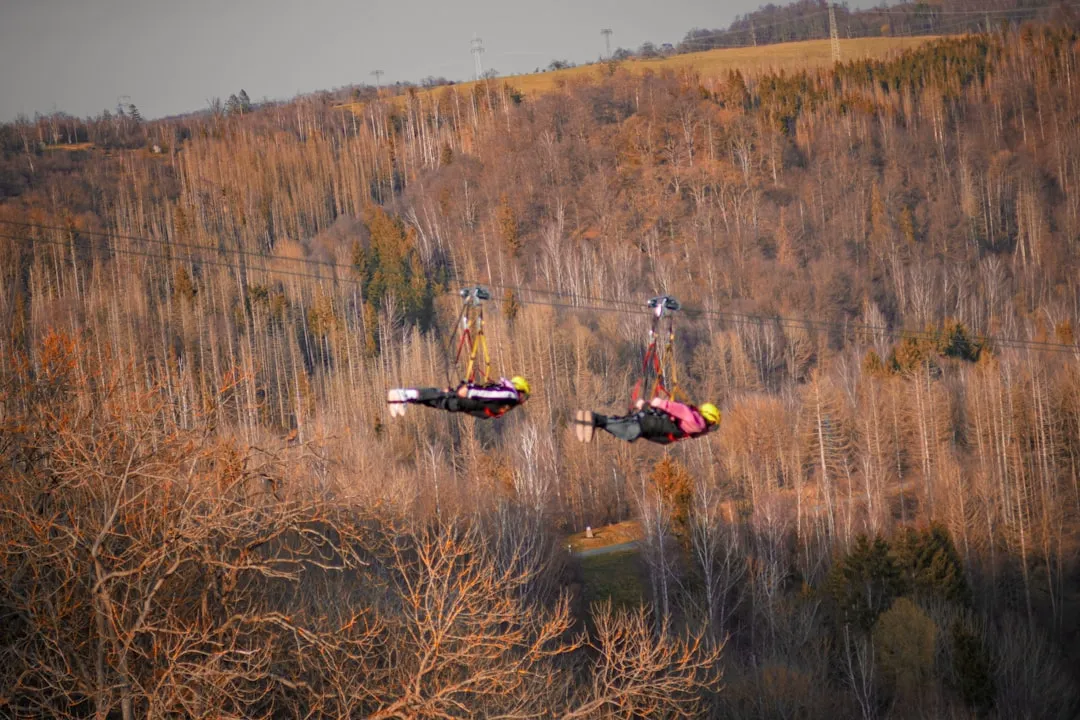
How We Build Safety: Understanding Zip Line Braking Systems
When you soar across a valley on a zip line, reaching speeds of 50 miles per hour or more, one question probably crosses your mind: "How exactly am I going to stop?" The answer lies in sophisticated braking systems that represent decades of engineering innovation—systems we take very seriously as professional zip line builders.
The Challenge of Controlled Stopping
Bringing a person traveling at high speed to a gentle, controlled stop is no simple engineering feat. The braking system must account for varying rider weights (from children to adults), weather conditions (humidity affects friction), cable tension, and the physics of momentum transfer. Get it wrong, and riders either stop too abruptly—risking injury—or don't stop at all.
Types of Braking Systems
Gravity Braking
The simplest approach uses the cable's natural incline. By designing the cable to slope upward at the arrival platform, gravity naturally slows the rider. However, this system has limitations—lighter riders may not reach the platform, while heavier riders may arrive too quickly.
Passive Magnetic Braking
Modern courses increasingly employ eddy current brakes, which use powerful magnets to create resistance without physical contact. As the trolley passes through a magnetic field, opposing forces slow the rider smoothly. These systems require minimal maintenance and provide consistent braking regardless of weather conditions.
"A well-designed braking system should feel invisible to riders—they should experience a smooth, controlled arrival that feels completely natural."
Active Braking Systems
The most sophisticated courses use computer-controlled active braking. Sensors detect the approaching rider's speed, and hydraulic or pneumatic systems adjust braking force in real-time. This technology ensures consistent, comfortable stops for every rider, regardless of weight or speed.
Redundancy: The Golden Rule
In professional zip line construction, we follow a fundamental principle: no single failure should ever result in injury. This means multiple independent braking mechanisms on every line. If the primary brake fails, a secondary system activates. Beyond that, energy-absorbing end stops provide a final backup that has never failed in properly engineered courses.
Understanding these systems helps tourists appreciate that their thrilling zip line experience is backed by serious engineering—the same engineering mindset that keeps bridges standing and aircraft flying safely.
← Back to Adventure Guide