What This Is
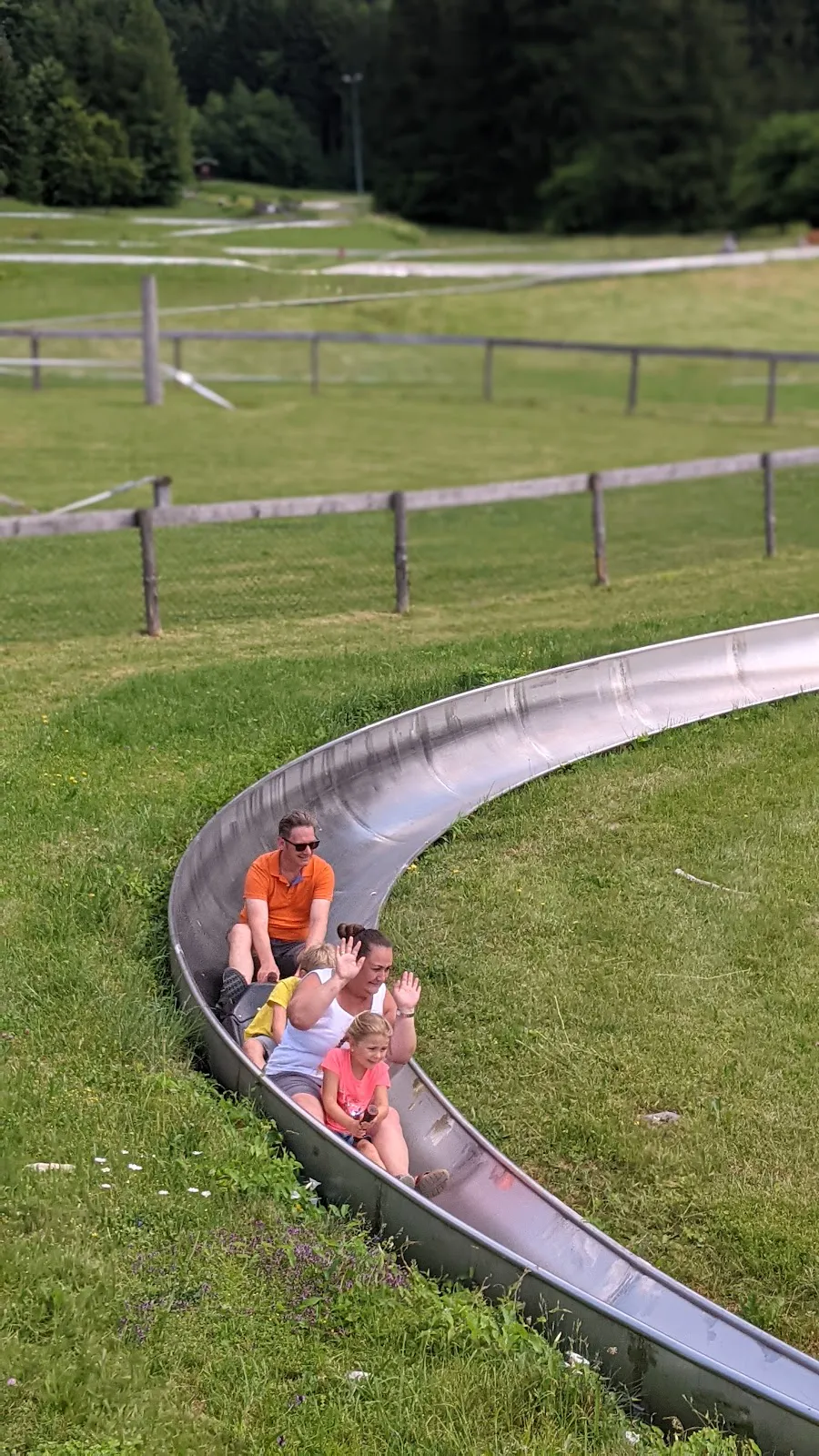
In the crowded marketplace of Tyrolean adventure tourism, the Wally Blitz Sommerrodelbahn in Elbigenalp occupies a unique, often misunderstood niche. To the uninitiated, it appears to be a standard-issue tourist attraction. However, a rigorous analysis reveals something far more intense: a 900-meter rail-guided coaster with a maximum 75% gradient—not a slope, but a controlled freefall. Named after the legendary "Geierwally" (Vulture Wally) who rappelled down cliffs to raid eagle nests, this ride is a mechanical reenactment of her death-defying plunge. At advertised speeds of 42 km/h on an open sled six inches off the ground, the sensation of speed is amplified by optical flow—and the narrow cart design creates a paradox where adults experience more thrill than children.
The 75% Factor
A 75% gradient approaches the angle of repose for loose rock. When your sled engages this section, gravity asserts dominance over friction. This is the defining thrill element that separates the Wally Blitz from gentle, meandering tracks designed for passive sightseeing.
The "Narrow Cart" Phenomenon
Unlike wide bucket-seat coasters, the narrow chassis creates perceived instability. Heavier riders (approaching 100kg) report feeling they might be "flung out" during high-speed cornering. Mechanically safe, psychologically terrifying. A feature, not a bug.
The Active Rider Requirement
This is interactive, not passive. Manual brake lever: push forward to accelerate, pull back to slow. The track elements only function as intended if you commit to the "no-brake" philosophy. Hesitation is punished with a stuttering, boring descent.
Track Specifications
Length: ~900m. Vertical drop: 181m (start at 1,226m elevation). Max speed: 42 km/h (centrifugal-governed). Elements: 25 curves, 4 jumps, 1 tunnel. Max gradient: 75%.
Pricing Strategy
Full price: €7-10 per ride. With Lechtal Aktiv Card: 50% off (~€3.50-5). Card is FREE from partner accommodations (from 2nd day of stay). The "Thrill Trilogy" of 3 runs costs ~€15 with card vs ~€30 without.
Parking Strategy
Destination: Untergiblen 15. Lot serves dual purpose (coaster + hikers to Gibler Alm). Risk: On clear summer weekends, fills by 10:30 AM. Strategy: Arrive before 10 AM or after 3 PM.
Access
VVT Regiobus Line 110 (Reutte-Warth). Stop: Elbigenalp Gemeindeamt. Critical: 1.4km uphill walk (15 min) from bus stop to coaster. Bus runs every 1-2 hours—missing one means 90-minute wait.
The Adrenaline Audit: Physics, Friction, and Fear
The Machine: Technical Deconstruction
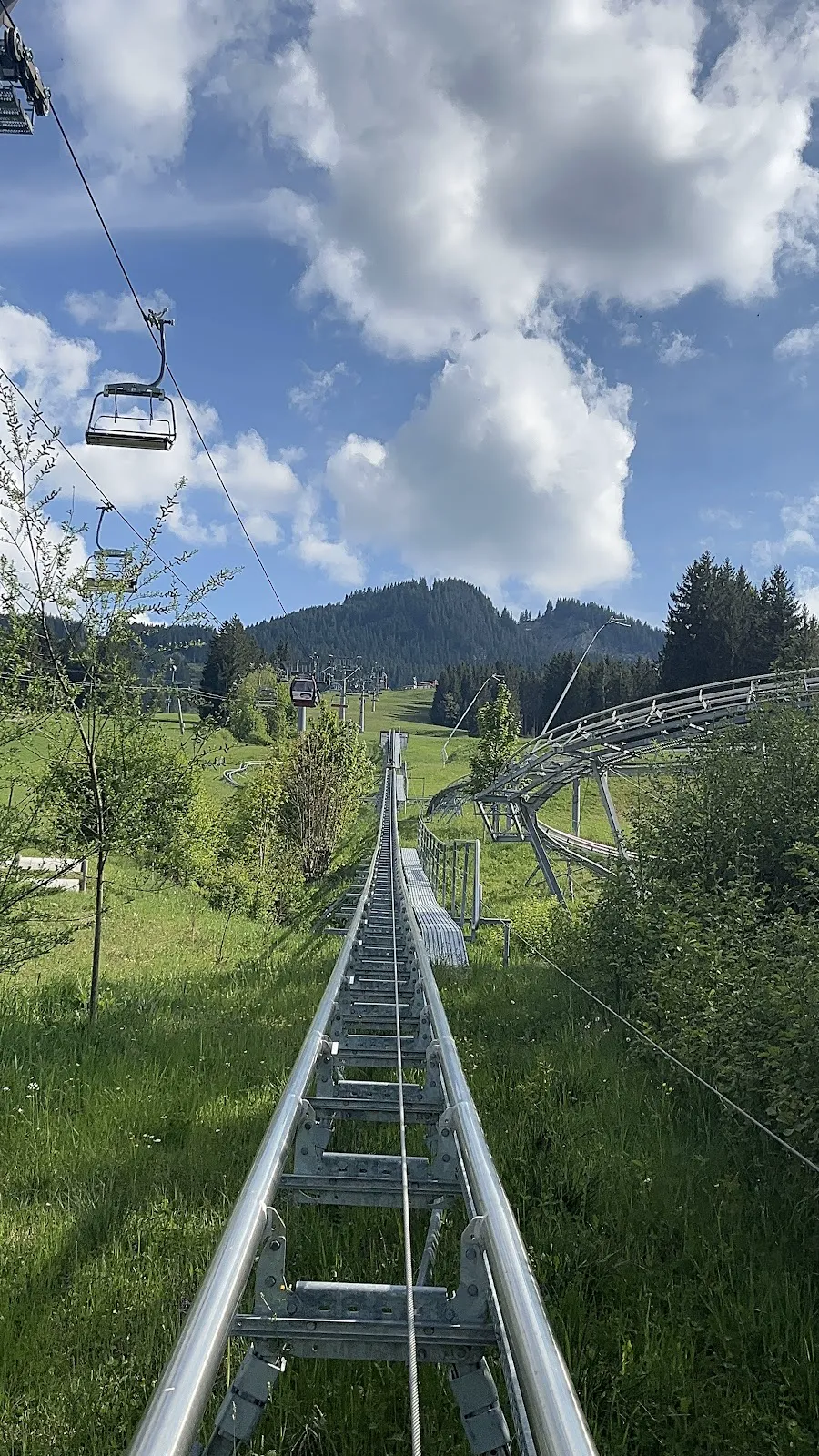
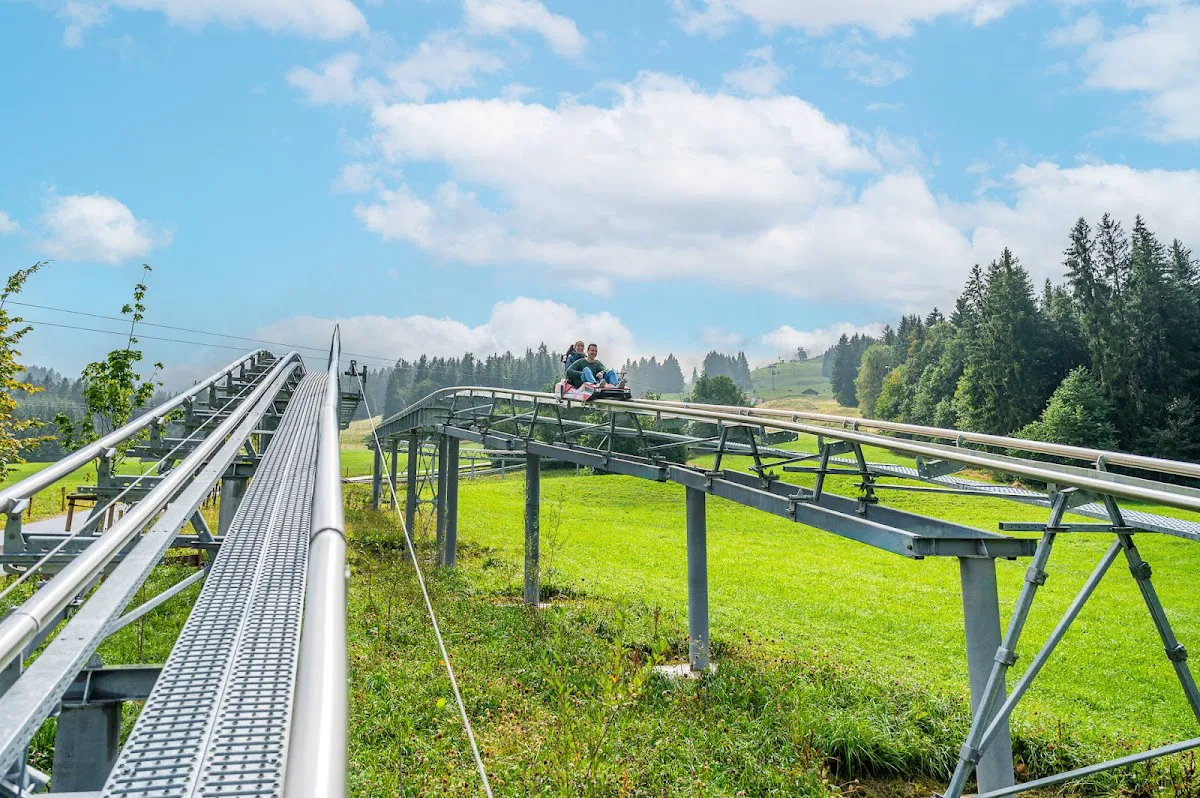
The ride operates in a taxonomical gray area between the traditional Sommerrodelbahn (trough-based, unattached sled) and the modern Alpine Coaster (fixed to tubular rails). The Wally Blitz is a single-track, rail-guided system—a design choice that significantly alters your relationship with physics.
| Technical Metric | Specification | Implications for the Rider |
|---|---|---|
| Track Length | ~900 meters | Short duration requires high-intensity riding to maximize value |
| Vertical Drop | 181 meters (1,226m start) | Significant potential energy; ensures rapid acceleration |
| Max Speed | 42 km/h | Regulated by centrifugal brakes, but feels faster due to ground proximity |
| Max Gradient | 75% | The "Freefall" sector—the defining thrill element |
| Elements | 25 Curves, 4 Jumps, 1 Tunnel | High frequency of directional changes; physically demanding on core |
| Cart Design | Narrow Chassis | High center of gravity increases perceived instability ("Ejection" Factor) |
| Max Weight | 130-140 kg | Heavier riders accelerate faster but have longer braking distances |
The "Narrow Cart" Phenomenon: Perceived Risk
User feedback from heavier riders—specifically those approaching 100kg or 1.9 meters in height—indicates a sharp spike in "perceived instability." Riders report feeling as though they might be "flung out" during high-speed cornering. While the rail system mechanically prevents the cart from tipping, the sensation of tipping is acute.
The Paradox: The ride is more thrilling for adults than for children. A 30kg child sits lower and feels planted. An 85kg adult has a higher center of mass relative to track width. When entering the steep curve at 40 km/h, lateral G-forces leverage this high center of mass, creating a powerful rolling sensation. The feeling of being on the ragged edge of control is the "gold standard" of thrill rides.
The Ascent: The Backward Tow
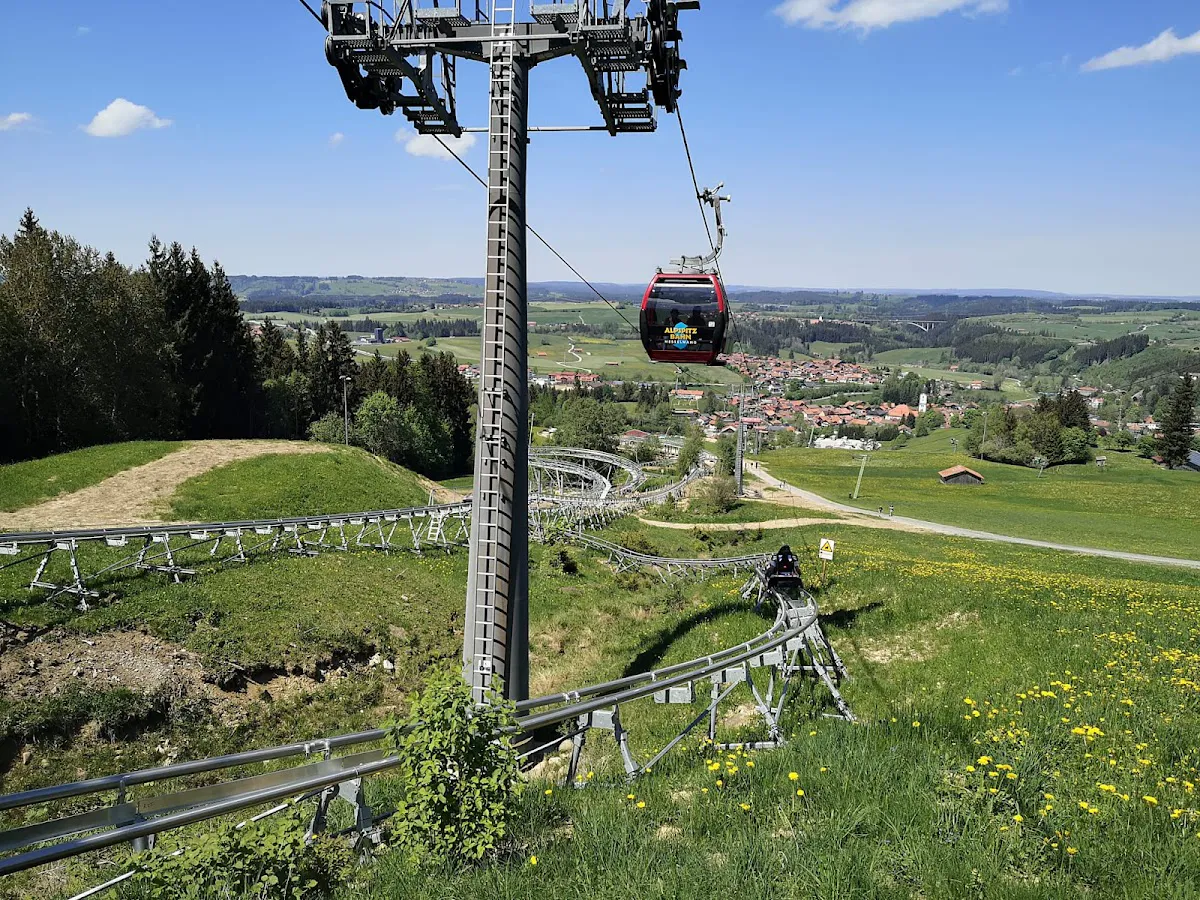
The experience begins not with the drop, but with the climb. The Wally Blitz utilizes the existing Knittel Tirol Ski Lift to drag riders backwards up the mountain. This is a crucial atmospheric detail: on many coasters, the ascent is a relaxed, forward-facing journey admiring peaks. Here, you stare down into the valley as the ground drops away—inducing mild vertigo and vulnerability before the ride even begins. You watch the safety of the valley floor recede, fully aware that gravity will soon return you there at high speed.
The Skill Spectrum: Braking Philosophy
Unlike a theme park roller coaster where you're passive cargo, the Alpine Coaster demands active participation. The sled is equipped with a manual brake lever: push forward to accelerate (release brakes), pull back to slow (engage friction pads). This introduces the human element—and human error— into the thrill equation.
The Three Rider Archetypes
| Archetype | Behavior | Result |
|---|---|---|
| The Tourist | Treats ride as scenic drive. Maintains consistent brake drag throughout. | Sled chatters and squeals. Corners neutralized. Jumps become non-events. Ruins experience for everyone behind them. |
| The Driver | Understands racing lines. Accelerates straights, brakes before sharpest corners. | Dynamic ride with moments of speed and control. The intended "safe" operational mode. |
| The Ace | Views brake lever as vestigial organ. Commits to 100% throttle descent. | High-G, wind-in-face rush. All 4 jumps deliver negative-G weightlessness. The CanopyTours target. |
The No-Brake Technique: Can you ride the Wally Blitz without braking? Reviewers confirm yes: "You are constantly tempted to want/have to [brake] but I made it down unscathed." The track handles the sled's maximum terminal velocity (capped at ~42 km/h). However, the psychological barrier is immense—the track feels too steep and the corners too tight for the speed. To survive: use your body weight. Lean into the apex of turns to stabilize the narrow cart and reduce lateral rollover sensation.
The Element Breakdown: Jumps and Tunnels
The four "jumps" are sharp, negative-G dips in the track profile. When hit at full throttle, these unload the suspension and your stomach, simulating weightlessness. If you brake before these sections, the effect is lost entirely—they become mere bumps. Speed is the catalyst.
The finale involves the "Schmidten Tunnel." Tunnels serve a specific optical function: the transition from bright alpine sunlight to dark, enclosed concrete forces rapid pupil dilation. This loss of visual reference points makes speed feel significantly faster in the dark—a classic disorientation tactic ensuring the ride ends on a sensory high note.
The Geierwally Mythos: Branding with a Vengeance
Context is the differentiator between a generic amusement park and a travel experience. The Wally Blitz is deeply embedded in the specific cultural fabric of the Lechtal.
Who is Wally?
The ride is named after Anna Stainer-Knittel, historically known as the "Geierwally" (Vulture Wally). Born in the Lechtal, she became a legend for rappelling down a sheer cliff face to raid an eagle's nest—a dangerous task typically reserved for men, done to protect the village's livestock. She became a symbol of Tyrolean female emancipation and rugged independence.
The lift operator, Knittel Tirol, shares her lineage. By naming the coaster the "Wally Blitz," the operators commodify the local legend of bravery. When you drop down that 75% gradient, you're participating in a sanitized, mechanized reenactment of the Geierwally's plunge.
The Cultural Ecosystem
This branding extends beyond the entrance sign. Elbigenalp calls itself "The Village" (Das Duarf) and is the cultural capital of the valley:
- Geierwally Open Air Stage: Located nearby in Bernhardstalschlucht gorge, performing plays dramatizing her life
- Wunderkammer Museum: Houses artifacts related to her history (€3 entry, good rain-day backup)
- Wood Carving Tradition: The valley's centuries-old craft heritage
The Wally Blitz is part of a coherent narrative. It justifies the trip to Elbigenalp as a cultural pilgrimage disguised as an adrenaline run. You're not just riding a coaster—you're engaging with the defining myth of the Upper Lech Valley.
The Economics: The "Aktiv" Arbitrage
A single ride costs roughly €7-10 for approximately 2-3 minutes (ascent included). The cost-per-minute is high—comparable to heliskiing or indoor skydiving. Paying full retail price for a single lap is economically inefficient and experientially shallow, as the first lap is always a "sighting lap" where you learn the track.
The Lechtal Aktiv Card: The Golden Ticket
The economic calculus changes dramatically with the Lechtal Aktiv Card, issued FREE to guests staying at partner accommodations (from the second day of stay).
| Scenario | Cost per Ride | Total for 3 Runs |
|---|---|---|
| Full Price | €7-10 | ~€30 |
| With Aktiv Card (50% off) | €3.50-5 | ~€15 |
The "Thrill Trilogy" Strategy
- Run 1 (Sighting): Learn the curves. Identify the braking points.
- Run 2 (Speed): Push the speed. Test the limits of the narrow cart.
- Run 3 (Mastery): The "Ace" run. No brakes. Full commitment.
The Aktiv Card also unlocks synergistic activities: discounted canyoning and rafting (€4-20 off), the Wunderkammer museum (€3 entry), and other valley attractions. Compounding value effect.
Weather & Operations: The Meteorological Variable
In the Alps, weather is the supreme arbiter of fun. For a metal-rail coaster, it's the kill switch.
The Friction Problem
The Wally Blitz relies on friction brakes (pads gripping the rail) and centrifugal brakes (internal mechanisms). When metal rails get wet, the coefficient of friction drops to near zero. Safe braking becomes impossible.
The Rule: "Bei Nässe... geschlossen" (Closed when wet). This is non-negotiable. There are no refunds for rain closures. Even if rain stops at 2:00 PM and sun comes out, the track remains closed until rails are dry—this "drying lag" can take 30-60 minutes.
The Webcam Strategy
Do NOT trust a general weather app that says "Partly Cloudy in Reutte." Reutte is 30km away. Elbigenalp has its own microclimate. Always check the Knittel Webcams for visual confirmation of dry pavement before leaving your hotel. If the asphalt at the base station looks dark (wet), the coaster is effectively a static sculpture.
Operating Hours
| Season | Dates | Hours |
|---|---|---|
| Core Season | July - August | Daily, 10:00 - 17:00 |
| Shoulder Season | May, June, September, October | Thursday - Sunday only |
The Trap: A traveler arriving on a Wednesday in late September will find a deserted lift and a locked gate. Always verify the specific daily schedule on the official website before transit.
Combo Strategy: The Lechtal Adventure Triangle
A trip to Elbigenalp for a 3-minute coaster ride is a poor use of a day. To maximize ROI of travel time, integrate the coaster into a broader "Adventure Cluster" with the Lech River as central spine.
The Holzgau Suspension Bridge
Approximately 9 kilometers upstream lies the village of Holzgau, home to the massive Suspension Bridge: 200 meters long, 110 meters high, spanning the Hohenbachtal gorge.
- The Synergy: Passive, vertigo-inducing height versus active, kinetic speed
- Access: Same Bus 110 connects Elbigenalp to Holzgau
- Cost: FREE to cross the bridge
The Wunderkammer (Rain Plan)
If weather turns and the coaster closes, the Wunderkammer in Elbigenalp is the strategic bailout—a "Cabinet of Curiosities" showcasing Lechtal history, including the Geierwally and the region's carving tradition. Saves the day from being a total washout.
The Gibler Alm Hike
Mountain hut accessible via ~1 hour hike starting near the coaster parking lot. Provides a bird's-eye view of the coaster track—watch riders navigate the course while you eat Kaiserschmarrn. Connects physical exertion of hiking with mechanical thrill of the ride.
Content Creation Gold
The GoPro Paradox
Official regulations state: "Cell phones must be securely stored" and large items must be handed in. Handheld filming is strictly prohibited—a dropped phone at 40 km/h is a projectile that could injure the rider behind or derail a sled.
The Workaround: Operations staff generally tolerate chest mounts or helmet straps provided they are hands-free and secured before entering the loading zone. Do not fumble with a selfie stick in the gate—you will be denied boarding. Chest mount is superior here: it frames the handlebars and your hands, capturing the vibration of the narrow cart that translates the "texture" of the ride to viewers.
The External Angle ("Instagram Money Shot")
The most dramatic photos are not taken on the ride, but of the ride. Stand near the perimeter fence at the "Steilkurve" (steep curve). Using a telephoto lens (or 3x smartphone zoom), compress the image of the rider banking hard against the Lechtal Alps backdrop. This sells the steepness of the terrain.
Insider Intel & Tactical Advice
- The Weight Variable: Heavy riders (over 90kg) accelerate faster due to mass overcoming rolling resistance. Momentum into uphill sections is greater. But braking distance is also increased—panic-braking late into a corner causes significant shuddering and skid.
- The Weekend Queue Trap: Capacity of a single-track coaster is limited by safety spacing. If operations sends carts every 30 seconds and the ride takes 3 minutes, throughput is low. A 50-person line can mean a 45-minute wait. Go weekdays or early morning.
- The "Tourist" Bottleneck: The single-track nature means a slow rider ahead ruins your experience. If stuck behind someone braking constantly, your adrenaline audit returns zero. Try to be first in line for the cleanest run.
- The Soundtrack: "Typical Austrian music" plays during the ascent, adding a layer of kitsch that contrasts sharply with the mechanical violence of the descent.
- Dining Strategy: Gasthof Stern and Hotel Post are established village inns— reliable, heavy, traditional fare. Gibler Alm food tastes better because you hiked for it. Avoid "Zur Geierwally" tourist pricing—check the fine print on the menu.
Practical Information
CanopyTours Scorecard
| Category | Score | Notes |
|---|---|---|
| Thrill Factor | 7.5/10 | 9/10 if ridden without brakes; 4/10 if ridden cautiously |
| Value (Full Price) | 4/10 | Expensive for duration (~€10/ride) |
| Value (Aktiv Card) | 9/10 | Excellent value at 50% off (~€5/ride) |
| Vibe | 8/10 | Authentic, rustic, embedded in local legend |
| Accessibility | 6/10 | Requires effort (Bus 110 + 15-min walk) |
| Instagram Potential | High | Valley views and aggressive banking angles |